The first variation is the one I'm familiar with. The second was different, and scarier.
Found here, on the blog of Jenn (the Clumsy Ninja).
Monday, June 14, 2010

Sunday, June 13, 2010
Black Eagle custom embroidered gi review...
Disclaimer: I'm sponsored by Black Eagle. They sent me this gi free. But I'm telling you, I have plenty of gis, so I really don't care if I piss them off, it's not like I depend on them to send me more in the future.
On that note you'll be expecting a bashfest, and you're going to be disappointed. I really like this gi! I got a single weight, white, custom embroidered gi and it's going to get a lot of use. I admit, I feel like a big cheese, at least a medium cheese, having a gi with embroidery on it. The downside is my training partners seem to think it merits extra choke attention or something. This just encourages my natural hedgehog jiu jitsu tendencies.
This is the Black Eagle logo (actually, a green eagle!) which is on both shoulders. That, plus a small label on the bottom of the front lapel, and two stripe labels on the side of the legs, is the only ornament that comes with this gi.

Seymour at Meerkatsu already wrote a very detailed and technical review of this gi in comparison with two others manufactured in the UK, found here, which I highly recommend you read. His photography is definitely superior, as well.
I ordered an A1, and measured it before and after washing/drying in the machine. Happily it is a shrink to fit kind of gi, because it was a little big on me at the start.
Measurements: in inches, out of the bag first then after 6 washes, the first in hot water, the rest in cold, in a hot dryer first and low heat after that.
Pants inseam 21.5/19
Pants outseam 36/33
Pants cuff 9.25/9
Jacket back 28/27
Jacket arm outside 20/19
Jacket front 28/27
Sleeve cuff 6/5.5
It did all the shrinking in the first go-around, so I was able to wear it the first time I trained after receiving it (at New Breed in California.) So you see, the pants got shorter, but the jacket didn't shrink too much. My A1 fits me perfectly. I really like that they sent a plain pair of pants for training as well as an embroidered pair. The gi is sewn with a great deal of attention to detail, from the triple stitching to the reinforced cuffs and the soft, thick, comfortable collar. The custom embroidery is SLICK... I sent an image file of my Red Menace logo (from NHBGear.com's printing people who made that patch for me) and one from my school website of the Relson Gracie logo.

The embroidery itself is super tight, very detailed, and well done. It's nothing like the crappy embroidery I had on a womens' Atama (the white gi with pink/blue embroidery.. the one I had tiedyed by Chris at Happy Kimonos.) which was frazzled and loopy and frayed almost from the get-go. The inside side of the embroidery is smooth, too, and not irritating on your back when you fight from guard. I did notice that the fabric-softener-sheet stuff that's stitched into a design like this, on the inside of the garment, did shred pretty quickly and get tossed, especially that underlaying the eagles on the shoulders, but it doesn't appear to have any detrimental effects on the design.

The pants are really nice. I wish the waist tie was cord, not flat fabric, but I haven't had problems with it yet like getting knotted up, being hard to pull or whatever. There are two loops in front, kind of lower and spread out pretty well, so no issues with the fabric cutting into my waist or hips. There's room for my junk in the trunk but not too much extra fabric.

I like having my school logo low on the front lapel, so you see it but still have room for other patches on the front, or can leave it plain if you desire.
My only complaint, such a small one, is that they didn't give the Relson Gracie shark a pupil in his eye. No biggie.

The single weave fabric feels like the Gameness Pearl weave. It's as sturdy to the hand as my Atama Mundials jackets (7 and 9) but not as stiff. It comes out of the dryer or air-tumble feeling silky soft, which is nice. The pants are sturdy too, but much softer and more fluid than Gameness pants. They're almost a bit fuzzy or peached in texture, but they haven't picked up dirt yet. Both pants and jacket breathe well and have been comfortable in the 100 degree heat, 3 hour classes here.
The single weave is on Black Eagle's site for 60 British pounds, which today is US $87.47. Getting your name embroidered on the back will run you an extra $8-11, depending on how big you want the letters. They'll also, of course, do your academy logo, and the cost starts at $25, depending on the number of stitches, intricacy of design, etc. Turnaround time is surprisingly quick considering the custom design and the overseas shipping-- as fast as a week or up to 2-3 weeks depending on their level of business.
I have been told that academies wanting to batch order gis with their school logos will get a good price for quantity orders.
They also do custom embroidered gi belts starting at $18, and custom embroidered back patches (to be sewn onto your gi) starting at $38.
That's my pitch... I think it's a sweet gi. I'm so torn when people ask me my favorite gi!
** My tiedye gi makes the list but simply because it looks so awesome-- the female Atama itself is fine, take or leave it.
** The Fenom gi (which just came out with a new model, the Lotus gi) is on the list because I like the company philosophy and because it's soooooo thick and soft at the same time, but I do kind of think it's not a depth-of-summer kind of gi for me.
** I find myself reaching for the Kauai nylon ripstop gi all the time because it's cool, light, and my hips move so well in it.
** My Vulkan Ultralight competition gi is great for IBJJF or when I'm fat, and it already has all my patches on it. I have to get some duplicate patches so my wardrobe has flexibility, LOL.
But overall, for a very sharp look and the most comfy fit and fabric, in hot weather or cold, I like my Black Eagle.
HILLARY WILLIAMS: FAIXA PRETA

Holy crap.
Hillary reffed me at my third tournament ever, my first NAGA, as a purple belt in December 2008. I was impressed already because I'd never had a female ref. She writes a great blog with insight into the international competition scene and from it you can start to see that she's a very down to earth, compassionate, dedicated, and yes, well-rounded person. She's far from one dimensional, and her ability to juggle success as a pre-med student, her dogs, her family, her dressage, her art, and her incredible travels for jiu jitsu... it's just so impressive to me. She always has a kind word; she's a very skilled teacher; she is very encouraging.
Her amazing tournament successes over the last two years (hell, over the life of her HOLYSHITSHORT career in jits) are just a few of the reasons she immensely deserves this black belt around her waist.
She was once a blue belt but not like me. Still, it's nice to know that even the best out there started out... down here. :)
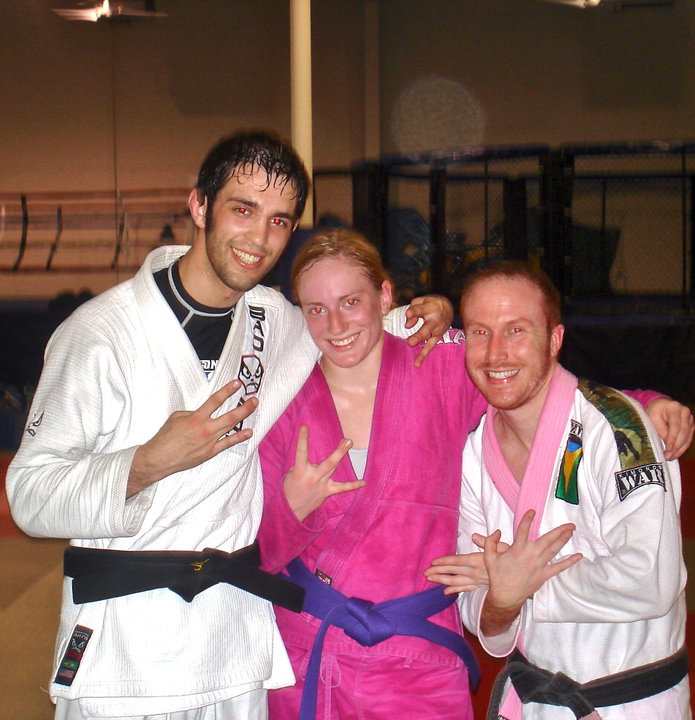
Parabens, Hillary.
Saturday, June 12, 2010
Lessons and report from the 2010 Mundials...

The Long Pyramid at Cal State Long Beach. Home of the Mundials! Can you believe I didn't even get a picture of the outside? It's blue-- I thought it would be glass, but no.
Here's the view from my seat for the first and third day. (I was on another mat for day two.)

You already know I had a great time. What a sweet gig- get paid for watching jiu jitsu, enough to fly out to California (sunny or no), stay with a dear friend, rent a car for a week and train two days on the end. Plus they feed you. Doesn't get better than that!
Here's my hostesses with the mostestes Heather and her dog Ashes. Heather, one of my best friends from high school, lives about 15 minutes from the Pan and about 20 from the Mundials so I will be enjoying her lovely Craftsman bungalow and her charming company each April and June for years to come :)

The brackets, first day. I'd say I scored 70 matches a day, average. Only 62 on one day; more than 80 on another. Of course blackbelt day was fewer.

Right before things got started, from upstairs where the vendors all set up, where the bathrooms are, and where the snack foodies live, not that I ever ate them. I brought apple slices, baby carrots, and scones for my refs, my ring coordinator, Tony (The Voice of Jiu Jitsu) and anyone else who wanted some. I was on mat 1-- bottom left hand corner. Behind that is the admin table and behind those yellow barricades at the bottom is the bull pen, where competitors get warmed up, IDs checked, weighed in, gis measured, and wait for matches.

I was not as blown away by Mundials mainly because I had a fair idea of what to expect after the Pan. This is not to say the jits wasn't impressive because you have to know it was, beyond a doubt. I was just more ready for it :) I still think my Pan Ams lessons apply at the Mundials, so I won't copy and paste, but here're some refinements.
My thoughts:
1. It's all about the guard. I saw a couple matches that stalled out on the feet, usually really big people or wrestlers. However, the majority of matches went to the ground fairly quickly. If you don't have a good takedown game, you pull guard or jump guard. Many matches especially at the higher levels started with both people RUNNING at each other and simultaneously sliding into home base (pulling halfguard.) From there, you simply CANNOT assume you'll be able to pass. Many, many matches at brown and above were 0-0 and decided on advantage(s) because guards just were impossible to pass. My noob eyes are simply lacking the vocabulary necessary to parse what was going on in some of the higher level matches. I knew peeps were trying for sweeps, but didn't know if the sweeps had names, if the setups were common or freakish one-offs, etc. Nevertheless, it is absolutely safe to say that play at the Mundials level is usually all about the guard.
2. Divide your training time to be 20% takedowns, 80% guard. Don't neglect takedowns! It's the easiest 2 points to get. If you're a top player, make that 80% proportion be about passing and subbing people while you pass. If you're a bottom player, make that about sweeps that follow immediately from the guard pull, or subs while you're being passed. Drill your triangle and armbar defenses and make them chained just like you have offensive series.
3. Gripfighting. Didn't see much of it at the lower levels. It's a big plus.
4. Turtle to avoid the guard pass points going to your opponent.
5. Know a bit of Portuguese and know the arm signals. Sorry, some of the refs don't speak much/any English. "Combach" (sp?) means "Fight" and is rather obvious. "Paro" means stop, as in "You're in someone else's mat space, come back here!" or "Time's up!" And you'll get warned for stalling by the ref tapping one of you and then grabbing his forearms, hands at the elbows if that makes sense. You have about 20 seconds or so to get moving or the staller gets a penalty; the victim gets an advantage. Second warning, the staller gets another penalty and the victim gets 2 points. Lots of people stopped completely when they got the stall signal and acted as if they didn't know what was going on, so I think that's something coaches need to inform their fighters about ahead of time.
6. No one low passes. I still saw mostly standing up in the guard to break guard, or elbows into the thighs, and then knee-through. I did not see low passes, Tozi passes, Wilson passes, etc.
7. Know your color. Ever wonder why the ref makes you switch which side you're standing on, or why you got the green belt? It's gi color, baby, and to make sure the ref gives the points to the right person. The ref's right hand has the green/yellow cuff on and that's the hand I watch for that person's points, advantages etc. The ref's left hand is the white (uncuffed) hand. That's also which side you stand on, at the start and at the end.
Who is which depends on gi color and bracketing. Blue vs white gi, the blue will be green and white is white. Black vs white gi, black is green and white is white. Blue vs black gi, blue is green and black is white. Refs with experience won't even bother with the belt for these matchups. If you're both in the same color gi, I believe the green belt goes to whoever's name is first in the bracket. This is also why IBJJF only allows blue, black and white gis and no mix/matching of pants and top.

Ultimately, you care about this because when you look up at the scoreboard (which you should) you want to know whether you're green or white so you know how you're doing in points.
8. Cross face. This was something I commented on at the Pan and now I get it. Grab the collar when you're postured up so you have arm length and use your forearm to crossface, use your bicep when you're down low.
9. Don't pull guard when they shoot. They'll get the takedown points because likely they're touching your leg.
10. People will stand on your leg, kneel on your face, etc. Be prepared for it and use it to your advantage when you're in a position to do so.
11. Majority of subs were classics (triangle, armbar, choke, kneebar) but it was the setup that set the more advanced people apart.
12. Remember your exact position and grips during a ref stoppage.
13. Know the rules about legal subs. Should go without saying. I still saw people DQ'd for reaping the knee. You can have a leg between their legs with your foot going towards the outside of their hip; you cannot have their leg and cross your foot from the outside to the inside of their hip. Make sense? 50/50 guard is okay; knee reaping, twisting knee locks etc. is NOT.

Now, aside from the "lessons" I took away from things.. my report. I was utterly CRUSHED to be instructed not to publish the video footage I'd been taking. I have some AMAZING matches. *sigh* However, I can tell you what I filmed, and if you ask me for it-- because it's your match, I will get it to you. And thanks to all of you who are sending me footage to show.. I promise I will get that up post haste!
In somewhat chronological order, from my ringside notes, here's the matches I have- sometimes I have weightclasses, sometimes no... I didn't always have a great note-taking system for my personal stuff since my attention and time was fully devoted to scoring matches and my personal notes only got scribbled in the downtime. Likewise the still photos only happened when a friend hanging out with me would grab my camera and snap a pic, except for blackbelt day when I actually took two-three pictures of the surroundings, the celebrations etc.
Day one: I wish I'd taped some, but I didn't. Thus you're missing out on the pena and leve blue belt female matches. Mackenzie Dern, Megaton's daughter, age 17, beat Jen Turner in the pena finals with a belly down armbar at 1:22. She has a super fast guard sit! Mackenzie got her purple on the podium but returned to fight (and win, I think) in the blue belt absolute the next day. And in blue belt female, leve class, 14 year old Dominyka Obelenyte defeated Erikka Flom in finals, 3-0.
Day two:
2 of Tracey Goodell, Lloyd Irvin-- she stormed the purple belt leve division. Here she is waiting for (I believe) her first match, just two weeks after being promoted from blue belt.

Alaina Hardie v Jen Whitcomb- quite the fierce match between two friends from GrappleCamp. Alaina won with a tough choke.
Purple belt, heavy weight: Cecilia Minshall (Team Renzo) v. Nellie Cavin (Gracie Barra). 3 person division, Cecilia and Nellie fought twice. Nellie won first match, 0-0, ref decision. Cecilia won their second matchup on points, 8-2, for the gold medal.
Middle weight purple finals- Alaina Hardie v. Kay Stephenson. Kay won with a bellydown armbar at 1:39.
Purple, leve? Travis Orr v. Medina-- Orr wins by triangle after being rudely thrown twice.
A match I think between Ronis Gracie, purple, Gracie Barra, and a black gi from Checkmat.
Ronis waiting for his match..

Ronis Gracie v. Faria(s) (sp?) Ronis won 2-0.
Jaxon Smith, purple from Machado in Redondo Beach, v. Roh, Jaxon by bow & arrow choke at 2:22.
Jaxon Smith v. Ronis Gracie. Gracie wins, 6-2.
Purple middle finals, Alec Baulding (Alliance) v. someone I can't read my notes. When I process that video I'll see if I can edit this with the correct name.
From day three, blacks and browns:
T. Hirata v. Felipe Costa-- Costa by armbar, I think. Again notes unclear.
A short clip of a random match with a very cool judo armbar, with both legs crossed over the arm you're barring (their near arm) and ankles are crossed right under their jaw. He didn't get the tap with this, but it was cool to look at and toy with.
Hillary Williams v. Weatherford, Hillary for the win.
Tove Soderston, who won the Pan I'm told, v. Fernanda Mazelli. Mazelli FTW.
Siyaka Shioda v. Bruna Ribeiro, kneebar by Shioda at :45, with Roger Gracie in the background.
Shioda v Kyra Gracie, who won on points 10-0. Here's Kyra going for an armbar, defended by Siyaka.
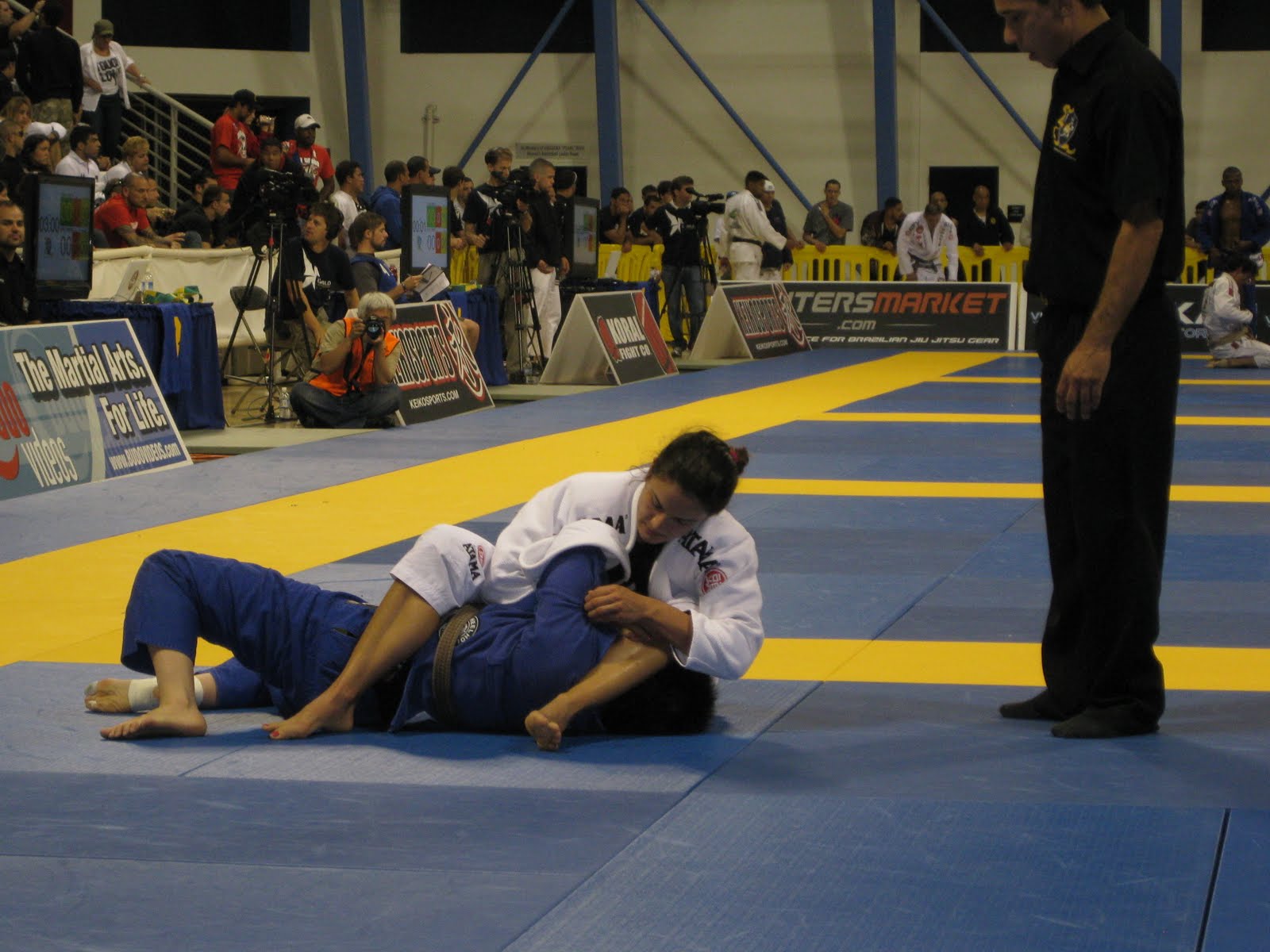
Luanna Alzuguir v. Penny Thomas, Luanna by choke. Here's Penny battling valiantly to pass Luanna's guard. On the video, this is EPIC WAR.

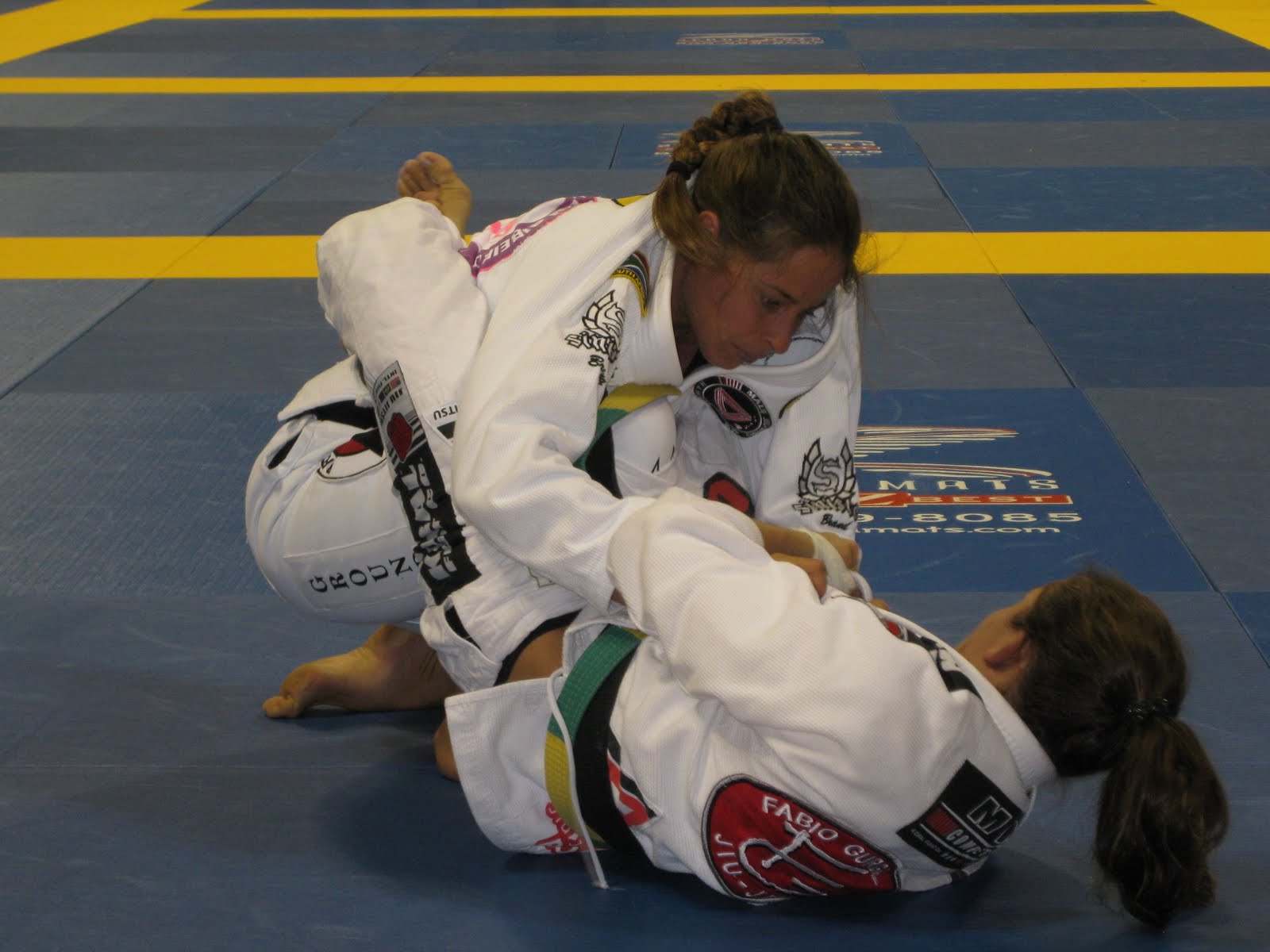
Fernanda Mazelli v. Michelle Nicolini, Michelle with the triangle-armbar in 2 minutes.
Hillary Williams v. Kyra Gracie, Kyra with the choke at 4:56.
Finals of the black belt weight class (galo? pluma?) T. Hirata v. Nazimiento (sp?) from Paragon, Nazimiento wins 13-4. I think this is a photo of them with Hirata on top. Let me know if I'm wrong. I think there's a mistake here, maybe this isn't finals but is absolute... or maybe I was mistaken about who prevailed in Hirata v. Costa.

Luanna v. Michelle, Luanna wins 10-2. Here's Michelle working the pass, shortly before Luanna scissor-sweeps her.

Beatriz "Bia" Mesquita v. Gaby Garcia, of course Garcia wins. This was on another mat so I don't know if a submission or by points, but my guess would be submission, americana from side control. Just a guess ;)
I didn't tape the match but here's Tammy Griego, Gracie Barra Albuquerque, and Bia after their match. Don't know who won.

Rhalan Gracie v. Armburst, Gracie for the win but I didn't write down how.
Kyra v. Luanna, Luanna wins 5-0.
Ian McPherson, brown belt phenom, v. Rhalan Gracie, with Ian winning 4-2.
Alec Baulding, Alliance's purple belt magician, chokes Bruno Pucci.
Karen Miller gets choked by Luanna at 1:56.
Val "Valhalla" Worthington v. Penny, who wins by choke, seen here..

Michelle v. Fernanda, with Michelle winning by toehold at :52.
Luiza Monteiro v. Penny, who won with a choke from mount.
Cobrinha v. Yokinori, with Cobrinha FTW 18-0. In the background you see Tracey Goodell v. Kay Stephenson, with Tracey pulling off a triangle. I think this was either semifinals or maybe just a division match.
Here's Cobrinha against someone, don't know who.

Ronis Gracie falls to Alec Baulding, didn't note how.
Fereira v. Clark Gracie, who won by choke.
Alves v. Marcelo Garcia, who wins by choke.
Carlquist v. Abmar Barbosa, who wins by mounted triangle in 1:27.
A Gracie kneebars Mendes but I didn't write whether it was Rafa or Guilherme, whether it was Kron or Clark or who.
Santana chokes Abmar Barbosa. In the background, you see the purple belt female absolute finals, Jacqueline Oliveira (Alliance) loses to Tracey Goodell by triangle.
Marcelo beats Mendes by Monson choke at 4:37. As a side note: damn I wish I had a better Monson choke.
Roger Gracie v. Luiz Fernando (I think) in semifinals. Shocker, Roger chokes him.
Day four-- da da DA- the blackbelt day:
Even though you've been through 4 days of the Pan and 3 days of Mundials, nothing quite prepares you for the absolute intensity of team spirit displayed on Sunday. Sorry, sometimes it was overboard, reminding me of high school antics, but whatever, I get that this is a REALLY BIG DEAL.
I did get to hang out a little while with Dustin from Kauai Kimonos and he showed me the custom gis they made for Felipe Costa. Way cool!

Sounds like the nylon ripstop gi is making its way through the IBJJF approval process. I'm going to review that gi SOON, I promise, but for now I can't say enough nice stuff about it especially in hot humid weather, for travel, and for facilitating hip movement. Eek, sorry, that sounds like a review.
Barra, Humaita, and Alliance all set up camp in a different section of the bleachers, wearing their special Mundials tshirts made for the occasion, waving banners, chanting and singing and generally lacking only short skirts and pompoms. This is the Alliance section. Sorry for the camera movement in the middle.
Another teensy little 2 second clip of someone celebrating, don't even remember who.
Here's Humaita's section before things got really going.

The IBJJF does a good job of running this tournament. On Sunday, there's only two mats set up, with mirror-image/linked scoreboards facing both sides of the mat to make it easy to spectate-- no matter where you sit, you can see the score, time left etc. for both matches. And I hear Budovideos did a better job of giving the women airtime- is that your opinion? I'm interested!

I only know of one screwup in terms of brackets etc. but it was a competitor error, not admin error. Two guys had had their IDs checked and were waiting to compete near some other waiting competitors. Apparently they didn't speak English. Why that matters I don't know, because when names were called, they answered to them-- even though THAT WASN'T THEIR NAME. So an Asian name was called-- Asian guy answers. Hispanic name called, Hispanic guy answers. Asian fights Hispanic and then we discover oops, they weren't supposed to fight each other. Easy mistake to make for the staff side, everyone starts to look alike, and you never expect someone to answer to the WRONG NAME! It was resolved quickly and no one was mad, but we all had a mini coronary, of course.
On Sunday, I was sooo excited by watching, and sooooooooooo nervous about making a mistake, that I just left the camera alone for the most part on blackbelt day. I had it running some, but without much input from me in terms of on, off, aiming, zooming, etc. I just didn't want even the appearance that I was distracted.
I did catch Rafa Mendes defeating Ryan Hall... Lucas Lepri v. Augusto Mendes (don't recall who won).. Cobrinha v. "Crazy" Mario Reis...
But most of the time I was just too busy and too intent on watching to mess with recording. Most of that jiu jitsu was over my head anyways, except for the finishes. I will say that, if you're going to compete at the brown or black belt level (and prolly purple, too) you better have an answer to the 50/50 guard, which I saw a LOT of.
At the very end, here's Roger, celebrating his absolute victory, bittersweet as Romulo Barral was unable to contest the finals due to his knee injury from semifinals..

After four days of sitting still watching all this you already know I was chomping at the bit to go train. And I did, at New Breed. I meant to get pictures with Val and John and Johnny and everyone there, but really it just doesn't occur to you to grab the camera when you're sopping wet and exhausted. No matter how happy being that way makes you :) So I just have this one photo, grabbed as I was leaving on Tuesday to catch my plane. That's Val in the way-back background choking someone from the back.

What a fantastic experience. I got to meet lots of people face to face for the first time, like Leoni from the UK, and Felicia Oh, and Alaina Hardie, and others I just know by their forum names, like NinjaBoy. I'm just starting to get the footage rendered from all those fights-- I have about 5 hours solid of film! Let me know if you have footage for me to share, or if I have your footage and you want it.
Can't wait for next year.
Friday, June 11, 2010
2010 Mundials-- coverage of the mens' division on Fightworks
This is as detailed and thorough a review of the mens' competition at this year's Mundials as anyone could desire. Check it out here on Fightworks Podcast.
I will be doing my own feeble review this weekend.. stay tuned.
I will be doing my own feeble review this weekend.. stay tuned.
Summer supper
Muahahahaha... I'm making weight by not making this meal. But if you don't have to make weight, then by all means throw this together in your kitchen. Everyone will love you for it.
Grilled Sausages, Onions and Peppers

Serves 4. Serve sausages as is or in toasted buns.
2 large onions, halved and cut into 1/4-inch-thick slices
1/2 teaspoon table salt
1/4 teaspoon ground black pepper
3 medium red bell peppers, seeded and quartered
13- by 9-inch disposable aluminum roasting pan
2 pounds hot or sweet Italian sausages (8 to 12 links)
1. Light large chimney starter filled with charcoal (6 quarts, or about 100 briquettes) and allow to burn until coals are fully ignited and partially covered with thin layer of ash, about 20 minutes. Build single-level fire by arranging coals evenly across bottom of grill. Position cooking grate over coals, cover grill, and heat until grate is hot, about 5 minutes; scrape grate clean with grill brush.
2. Meanwhile, combine onions, salt, and pepper in medium microwave-safe bowl. Cover with plastic wrap and microwave on high power until onions begin to soften and tips turn slightly translucent, 4 to 6 minutes, stirring once halfway through cooking (be careful of steam). Transfer onions to disposable roasting pan. Place sausages and peppers in single layer over onions and wrap roasting pan tightly with foil.
3. Place roasting pan in center of grill, cover grill, and cook 15 minutes. Move pan to one side of grill and carefully remove foil cover. Using tongs, place sausages and peppers on grate directly over coals. Grill sausages, uncovered, turning every 1 to 2 minutes, until golden brown on all sides, 5 to 7 minutes. Grill pepper pieces, turning once, until charred patches form, 5 to 7 minutes. Transfer sausages and peppers to platter and loosely tent with foil. Cover grill and continue cooking onions, stirring occasionally, until liquid evaporates and onions begin to brown, 5 to 10 minutes longer. Serve sausages, passing onions and peppers separately.
French Potato Salad with Dijon Mustard
Serves 6 as a side dish.

If fresh chervil isn’t available, substitute an additional 1/2 tablespoon of minced parsley and an additional 1/2 teaspoon of tarragon. Serve the salad warm, but to make ahead, follow the recipe through step 2, cover with plastic wrap, and refrigerate. Before serving, bring the salad to room temperature, then add the shallots and herbs.
2 pounds small red potatoes (about 2-inch diameter), unpeeled, scrubbed, and cut into 1/4-inch-thick slices
2 tablespoons table salt
1 medium clove garlic , peeled and threaded on skewer
1 1/2 tablespoons champagne vinegar or white wine vinegar
2 teaspoons Dijon mustard
1/4 cup olive oil
1/2 teaspoon ground black pepper
1 small shallot , minced (about 2 tablespoons)
1 tablespoon minced fresh chervil leaves
1 tablespoon minced fresh parsley leaves
1 tablespoon minced fresh chives
1 teaspoon minced fresh tarragon leaves
1. Place potatoes, 6 cups cold tap water, and salt in large saucepan; bring to boil over high heat, then reduce heat to medium. Lower skewered garlic into simmering water and partially blanch, about 45 seconds. Immediately run garlic under cold tap water to stop cooking; remove garlic from skewer and set aside. Continue to simmer potatoes, uncovered, until tender but still firm (thin-bladed paring knife can be slipped into and out of center of potato slice with no resistance), about 5 minutes. Drain potatoes, reserving 1/4 cup cooking water. Arrange hot potatoes close together in single layer on rimmed baking sheet.
2. Press garlic through garlic press or mince by hand. Whisk garlic, reserved potato cooking water, vinegar, mustard, oil, and pepper in small bowl until combined. Drizzle dressing evenly over warm potatoes; let stand 10 minutes.
3. Toss shallot and herbs in small bowl. Transfer potatoes to large serving bowl; add shallot/herb mixture and mix gently with rubber spatula to combine. Serve immediately.

Icebox Key Lime Pie
Serves 8 to 10
Crust
8 whole graham crackers, broken into smaller pieces
2 tablespoons sugar
5 tablespoons unsalted butter, melted
Filling
1/4 cup sugar
1 tablespoon grated lime zest (regular limes, not Key)
8 ounces cream cheese, softened
1 (14-ounce) can sweetened condensed milk
1/3 cup instant vanilla pudding mix (no cooking required type)
1 1/4 teaspoons unflavored gelatin
1 cup fresh lime juice from 6 to 8 regular limes (not Key)
1 teaspoon vanilla extract
1. For the crust: Adjust oven rack to middle position and heat oven to 350 degrees. Pulse crackers and sugar in food processor until finely ground. Add melted butter in steady stream while pulsing until crumbs resemble damp sand. Using bottom of dry measuring cup, press crumbs firmly into bottom and sides of 9-inch pie plate. Bake until fragrant and browned around edges, 12 to 14 minutes. Cool completely.
2. For the filling: Process sugar and zest in food processor until sugar turns bright green, about 30 seconds. Add cream cheese and process until combined, about 30 seconds. Add condensed milk and pudding mix and process until smooth, about 30 seconds. Scrape down sides of bowl. Stir gelatin and 2 tablespoons lime juice in small bowl. Heat in microwave for 15 seconds; stir until dissolved. With machine running, pour gelatin mixture, remaining lime juice, and vanilla through feed tube and mix until thoroughly combined, about 30 seconds.
3. Pour filling into cooled crust, cover with plastic, and refrigerate at least 3 hours or up to 2 days. To serve, let pie sit at room temperature for 10 minutes before slicing.
Grilled Sausages, Onions and Peppers

Serves 4. Serve sausages as is or in toasted buns.
2 large onions, halved and cut into 1/4-inch-thick slices
1/2 teaspoon table salt
1/4 teaspoon ground black pepper
3 medium red bell peppers, seeded and quartered
13- by 9-inch disposable aluminum roasting pan
2 pounds hot or sweet Italian sausages (8 to 12 links)
1. Light large chimney starter filled with charcoal (6 quarts, or about 100 briquettes) and allow to burn until coals are fully ignited and partially covered with thin layer of ash, about 20 minutes. Build single-level fire by arranging coals evenly across bottom of grill. Position cooking grate over coals, cover grill, and heat until grate is hot, about 5 minutes; scrape grate clean with grill brush.
2. Meanwhile, combine onions, salt, and pepper in medium microwave-safe bowl. Cover with plastic wrap and microwave on high power until onions begin to soften and tips turn slightly translucent, 4 to 6 minutes, stirring once halfway through cooking (be careful of steam). Transfer onions to disposable roasting pan. Place sausages and peppers in single layer over onions and wrap roasting pan tightly with foil.
3. Place roasting pan in center of grill, cover grill, and cook 15 minutes. Move pan to one side of grill and carefully remove foil cover. Using tongs, place sausages and peppers on grate directly over coals. Grill sausages, uncovered, turning every 1 to 2 minutes, until golden brown on all sides, 5 to 7 minutes. Grill pepper pieces, turning once, until charred patches form, 5 to 7 minutes. Transfer sausages and peppers to platter and loosely tent with foil. Cover grill and continue cooking onions, stirring occasionally, until liquid evaporates and onions begin to brown, 5 to 10 minutes longer. Serve sausages, passing onions and peppers separately.
French Potato Salad with Dijon Mustard
Serves 6 as a side dish.

If fresh chervil isn’t available, substitute an additional 1/2 tablespoon of minced parsley and an additional 1/2 teaspoon of tarragon. Serve the salad warm, but to make ahead, follow the recipe through step 2, cover with plastic wrap, and refrigerate. Before serving, bring the salad to room temperature, then add the shallots and herbs.
2 pounds small red potatoes (about 2-inch diameter), unpeeled, scrubbed, and cut into 1/4-inch-thick slices
2 tablespoons table salt
1 medium clove garlic , peeled and threaded on skewer
1 1/2 tablespoons champagne vinegar or white wine vinegar
2 teaspoons Dijon mustard
1/4 cup olive oil
1/2 teaspoon ground black pepper
1 small shallot , minced (about 2 tablespoons)
1 tablespoon minced fresh chervil leaves
1 tablespoon minced fresh parsley leaves
1 tablespoon minced fresh chives
1 teaspoon minced fresh tarragon leaves
1. Place potatoes, 6 cups cold tap water, and salt in large saucepan; bring to boil over high heat, then reduce heat to medium. Lower skewered garlic into simmering water and partially blanch, about 45 seconds. Immediately run garlic under cold tap water to stop cooking; remove garlic from skewer and set aside. Continue to simmer potatoes, uncovered, until tender but still firm (thin-bladed paring knife can be slipped into and out of center of potato slice with no resistance), about 5 minutes. Drain potatoes, reserving 1/4 cup cooking water. Arrange hot potatoes close together in single layer on rimmed baking sheet.
2. Press garlic through garlic press or mince by hand. Whisk garlic, reserved potato cooking water, vinegar, mustard, oil, and pepper in small bowl until combined. Drizzle dressing evenly over warm potatoes; let stand 10 minutes.
3. Toss shallot and herbs in small bowl. Transfer potatoes to large serving bowl; add shallot/herb mixture and mix gently with rubber spatula to combine. Serve immediately.
Icebox Key Lime Pie
Serves 8 to 10
Crust
8 whole graham crackers, broken into smaller pieces
2 tablespoons sugar
5 tablespoons unsalted butter, melted
Filling
1/4 cup sugar
1 tablespoon grated lime zest (regular limes, not Key)
8 ounces cream cheese, softened
1 (14-ounce) can sweetened condensed milk
1/3 cup instant vanilla pudding mix (no cooking required type)
1 1/4 teaspoons unflavored gelatin
1 cup fresh lime juice from 6 to 8 regular limes (not Key)
1 teaspoon vanilla extract
1. For the crust: Adjust oven rack to middle position and heat oven to 350 degrees. Pulse crackers and sugar in food processor until finely ground. Add melted butter in steady stream while pulsing until crumbs resemble damp sand. Using bottom of dry measuring cup, press crumbs firmly into bottom and sides of 9-inch pie plate. Bake until fragrant and browned around edges, 12 to 14 minutes. Cool completely.
2. For the filling: Process sugar and zest in food processor until sugar turns bright green, about 30 seconds. Add cream cheese and process until combined, about 30 seconds. Add condensed milk and pudding mix and process until smooth, about 30 seconds. Scrape down sides of bowl. Stir gelatin and 2 tablespoons lime juice in small bowl. Heat in microwave for 15 seconds; stir until dissolved. With machine running, pour gelatin mixture, remaining lime juice, and vanilla through feed tube and mix until thoroughly combined, about 30 seconds.
3. Pour filling into cooled crust, cover with plastic, and refrigerate at least 3 hours or up to 2 days. To serve, let pie sit at room temperature for 10 minutes before slicing.
Marcelo Garcia, Ryan Hall, Jeff Glover-- jits porn.
And a little jitsporn... Marcelo, a highlight reel I might not have shared...
And Jeff Glover's seminar at New Breed in Chicago.. check out the cute butterfly sweep and then cartwheel pass around 3:00...
And back in 1997, Fabio Gurgel and Leo Vieira ...
Happy Friday ya'll... I'm hitting open mat hard today, then churrascaria at night to celebrate hubby's 40th bday.
Thursday, June 10, 2010
Kron Gracie v. Sergio Moraes, 2010 Mundials
Courtesy of Todd Holt and originally found here on MMA Video Warehouse.
p.s. that's not me at the scoring table.
Flying omoplata, purple belt absolute, Mundials 2010
Alec Baulding (Alliance) against a giant guy from Team Lloyd Irvin... around 4:30...
I was scoring down at the end of the floor on Mat 1 when this happened but I did look up when the building went NUTS at the end of this match...
I was scoring down at the end of the floor on Mat 1 when this happened but I did look up when the building went NUTS at the end of this match...
20,000 Leaks Under the Sea
From Slate:
The insanity of deepwater oil wells.
By William Saletan, originally found here.
From the comfort of your home or office, through the magic of Web video, you can watch the disaster unfolding on the floor of the Gulf of Mexico. What you're seeing—a leak that has spewed more than 36 million gallons of oil into the Gulf since April 20—is taking place a mile below the water's surface. The temperature there is just above freezing. The pressure is 2,300 pounds per square inch.
No human being could survive there. Everything at the scene—pipes, valves, hydraulic systems—has been remotely installed, through cables, by machines floating on the water's surface. So has the well, which plunges from the sea bed through another 2.5 miles of earth to the oil deposit below.

If nobody's down there, how are you seeing this? Through the eyes of remotely operated vehicles. For six weeks, these undersea drones, built to withstand seawater and crushing weight, have been busy around the leak, trying to shut it down. They've twisted valves, clipped hoses, sprayed dispersant, and poked at the well's unresponsive "blowout preventer." Nothing has stopped the leak. It will go on hemorrhaging oil until an 18,000-foot relief well reaches its source, probably in August.
You can see the spewing oil pipe, but you can't touch it. None of us can. We can't reach it. We've opened a hole in the earth that we can't close.

I'm not talking about the blowout. I'm talking about the well. Every month, we punch more holes in the bottom of the sea. Driven by high gas prices and the depletion of accessible oil fields, drillers are venturing farther offshore and deeper into the earth. Thirty years ago, the record water depth for a functioning rig was less than 5,000 feet. Now it's more than 10,000 feet. One well runs through 4,000 feet of water and another 35,000 feet of earth. Another has been proposed to go through two miles of water and seven miles of earth. Nearly 10 percent of today's oil comes from deepwater wells.
The wells have blowout preventers. But if the preventers fail, as this one did, there's no known way to plug them. Safety regulations generally prohibit diving below 300 feet. The lowest depth attained by a human diver is 2,000 feet, and that was in a suit that makes activity impossible. In deep water, we're at the mercy of ROVs.
ROVs do amazing things. On BP's Web site, you can watch a video about them. (You can even select one of the ROVs near the well, click on it, and see what it's seeing.) They can function at depths of 10,000 feet or greater. They can swim, dig trenches, and install undersea cables. With multiple-jointed manipulators, they can clamp pipes, drill holes, and cut wires. The Marine Technology Society says "a telerobotic manipulator is the mechanical equivalent of human arms and hands."
But it isn't. For weeks, BP's ROVs have fumbled with tools and cables. The high-tech saw they brought to sever the leaking pipe failed, got stuck, and took hours to extract. On Friday, Tony Hayward, the company's CEO, apologized for the inherent slowness of remotely orchestrating operations that would be simple and fast for a human. And on Monday, when a reporter suggested that more ROVs might fix the leak, Adm. Thad Allen, the government's spill-control commander, answered him with an embarrassing story:
When we were using the riser insertion tool … they had to stop and reinsert it. The reason they had to do that was the ROVs that were doing the subsea dispersant application and the ROVs that were working the insertion tube actually bumped into each other, and it caused the tube to be dislodged, and they had to do it again.
The ROVs' clumsiness isn't their fault. It's ours. Watch the BP video. Around two minutes in, it shows an ROV pilot in training. Look at the device he's been given to operate the machine. It can't possibly mimic the dexterity of a hand.
BP treats the awkwardness of this technology as an excuse for its difficulties. "Five thousand feet of water, no humans could go down there," the company's managing director, Robert Dudley, pleaded last week on Meet the Press. "We're reliant on the robots. These guys that are working offshore are incredibly skilled at this. We've been asking them to do the equivalent of open heart surgery on television."
But if this is heart surgery, the wound that made it necessary was inflicted by the surgeons themselves. BP drilled the well. It did so knowing that its robots couldn't handle a blowout and its people couldn't get there. If a surgeon did that—if he opened a hole he couldn't reach to stop the hemorrhage—he'd lose his license.
Of all the lessons we can learn from the BP fiasco, the simplest, and the first we should apply to offshore-drilling laws, is this: Don't open any holes you can't close. If the well site is too deep for humans to reach, drill a simultaneous relief well so you can plug a blowout promptly. If a relief well is too expensive, don't drill at all. Or you can keep robots on hand to shut down leaks. But they'll have to be better robots than the ones we're now watching.
Today's laws don't come anywhere near this standard. Two years ago, the government narrowed the conditions under which oil companies had to prepare for blowouts Last year, when BP filed its exploration plan for the site of the ill-fated well, it claimed, "A scenario for a potential blowout of the well from which BP would expect to have the highest volume of liquid hydrocarbons is not required." The government agreed and approved the plan. Since the blowout, the government has granted environmental waivers to six projects that would drill in even deeper water, including four wells at more than 9,000 feet. And the government's only requirement for ROVs is that they be armed to activate the blowout preventer. Once the preventer has conclusively failed, nothing more is expected of them.

"If something like this happened in a shallow-water well, then folks would just get up on the platform and they would start fixing it and it would be shut down fairly quickly," President Obama observed yesterday. "What we don't have right now is an assurance that in these incredible depths—a mile down, and then they're drilling another three miles down to get to oil—that we can actually handle a crisis like this." That's exactly right. The problem isn't just that a blowout preventer failed. It's that we have no way to repair the next blowout. And until we do, we're fools to keep drilling in the deep.

The insanity of deepwater oil wells.
By William Saletan, originally found here.
From the comfort of your home or office, through the magic of Web video, you can watch the disaster unfolding on the floor of the Gulf of Mexico. What you're seeing—a leak that has spewed more than 36 million gallons of oil into the Gulf since April 20—is taking place a mile below the water's surface. The temperature there is just above freezing. The pressure is 2,300 pounds per square inch.
No human being could survive there. Everything at the scene—pipes, valves, hydraulic systems—has been remotely installed, through cables, by machines floating on the water's surface. So has the well, which plunges from the sea bed through another 2.5 miles of earth to the oil deposit below.
If nobody's down there, how are you seeing this? Through the eyes of remotely operated vehicles. For six weeks, these undersea drones, built to withstand seawater and crushing weight, have been busy around the leak, trying to shut it down. They've twisted valves, clipped hoses, sprayed dispersant, and poked at the well's unresponsive "blowout preventer." Nothing has stopped the leak. It will go on hemorrhaging oil until an 18,000-foot relief well reaches its source, probably in August.
You can see the spewing oil pipe, but you can't touch it. None of us can. We can't reach it. We've opened a hole in the earth that we can't close.

I'm not talking about the blowout. I'm talking about the well. Every month, we punch more holes in the bottom of the sea. Driven by high gas prices and the depletion of accessible oil fields, drillers are venturing farther offshore and deeper into the earth. Thirty years ago, the record water depth for a functioning rig was less than 5,000 feet. Now it's more than 10,000 feet. One well runs through 4,000 feet of water and another 35,000 feet of earth. Another has been proposed to go through two miles of water and seven miles of earth. Nearly 10 percent of today's oil comes from deepwater wells.
The wells have blowout preventers. But if the preventers fail, as this one did, there's no known way to plug them. Safety regulations generally prohibit diving below 300 feet. The lowest depth attained by a human diver is 2,000 feet, and that was in a suit that makes activity impossible. In deep water, we're at the mercy of ROVs.
ROVs do amazing things. On BP's Web site, you can watch a video about them. (You can even select one of the ROVs near the well, click on it, and see what it's seeing.) They can function at depths of 10,000 feet or greater. They can swim, dig trenches, and install undersea cables. With multiple-jointed manipulators, they can clamp pipes, drill holes, and cut wires. The Marine Technology Society says "a telerobotic manipulator is the mechanical equivalent of human arms and hands."
But it isn't. For weeks, BP's ROVs have fumbled with tools and cables. The high-tech saw they brought to sever the leaking pipe failed, got stuck, and took hours to extract. On Friday, Tony Hayward, the company's CEO, apologized for the inherent slowness of remotely orchestrating operations that would be simple and fast for a human. And on Monday, when a reporter suggested that more ROVs might fix the leak, Adm. Thad Allen, the government's spill-control commander, answered him with an embarrassing story:
When we were using the riser insertion tool … they had to stop and reinsert it. The reason they had to do that was the ROVs that were doing the subsea dispersant application and the ROVs that were working the insertion tube actually bumped into each other, and it caused the tube to be dislodged, and they had to do it again.
The ROVs' clumsiness isn't their fault. It's ours. Watch the BP video. Around two minutes in, it shows an ROV pilot in training. Look at the device he's been given to operate the machine. It can't possibly mimic the dexterity of a hand.
BP treats the awkwardness of this technology as an excuse for its difficulties. "Five thousand feet of water, no humans could go down there," the company's managing director, Robert Dudley, pleaded last week on Meet the Press. "We're reliant on the robots. These guys that are working offshore are incredibly skilled at this. We've been asking them to do the equivalent of open heart surgery on television."
But if this is heart surgery, the wound that made it necessary was inflicted by the surgeons themselves. BP drilled the well. It did so knowing that its robots couldn't handle a blowout and its people couldn't get there. If a surgeon did that—if he opened a hole he couldn't reach to stop the hemorrhage—he'd lose his license.
Of all the lessons we can learn from the BP fiasco, the simplest, and the first we should apply to offshore-drilling laws, is this: Don't open any holes you can't close. If the well site is too deep for humans to reach, drill a simultaneous relief well so you can plug a blowout promptly. If a relief well is too expensive, don't drill at all. Or you can keep robots on hand to shut down leaks. But they'll have to be better robots than the ones we're now watching.
Today's laws don't come anywhere near this standard. Two years ago, the government narrowed the conditions under which oil companies had to prepare for blowouts Last year, when BP filed its exploration plan for the site of the ill-fated well, it claimed, "A scenario for a potential blowout of the well from which BP would expect to have the highest volume of liquid hydrocarbons is not required." The government agreed and approved the plan. Since the blowout, the government has granted environmental waivers to six projects that would drill in even deeper water, including four wells at more than 9,000 feet. And the government's only requirement for ROVs is that they be armed to activate the blowout preventer. Once the preventer has conclusively failed, nothing more is expected of them.

"If something like this happened in a shallow-water well, then folks would just get up on the platform and they would start fixing it and it would be shut down fairly quickly," President Obama observed yesterday. "What we don't have right now is an assurance that in these incredible depths—a mile down, and then they're drilling another three miles down to get to oil—that we can actually handle a crisis like this." That's exactly right. The problem isn't just that a blowout preventer failed. It's that we have no way to repair the next blowout. And until we do, we're fools to keep drilling in the deep.

Subscribe to:
Posts (Atom)